- The Neural Frontier
- Posts
- OpenAI’s $555,000 hire is coming!
OpenAI’s $555,000 hire is coming!
Also: Meta acquires Manus, the AI agent company.

The Neural Frontier
January 02, 2026
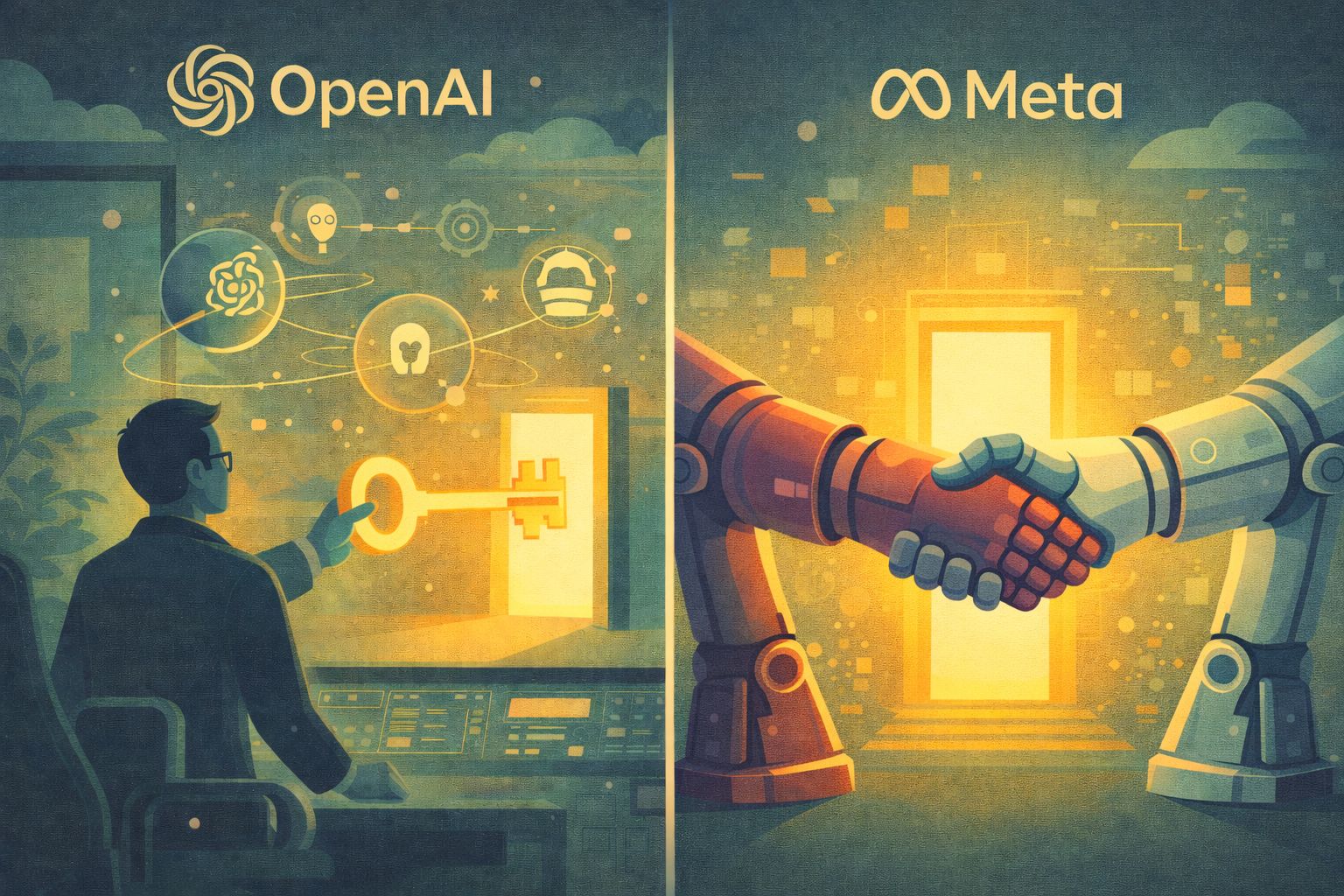
New year, new acquisitions, new mouth-watering jobs in the AI space, and perhaps, a new you?
Forward thinkers, welcome to another issue of the Neural Frontier.
Let’s kick off the new year with acquisitions and lucrative compensations, shall we?
In a rush? Here's your quick byte:
🏢 OpenAI’s $555,000 hire is coming!
💸 Meta acquires Manus, the AI agent company.
⚡ The Neural Frontier’s weekly spotlight: 3 AI tools making the rounds this week.

Source: Jakub Porzycki/NurPhoto / Getty Images
OpenAI is looking for a new Head of Preparedness, a senior executive role tasked with studying and mitigating emerging AI risks — from cybersecurity and biological misuse to mental health and self-improving systems.
In announcing the role on X, CEO Sam Altman acknowledged that today’s models are no longer just impressive — they’re starting to present real challenges. He specifically pointed to AI systems that can uncover critical software vulnerabilities and the growing concern around AI’s impact on users’ mental health.
🧠 What the role actually covers
This isn’t a policy comms job. The Head of Preparedness is responsible for executing OpenAI’s Preparedness Framework — the company’s internal system for identifying, evaluating, and mitigating risks posed by frontier models.
According to the job listing, the role owns:
Threat modeling for high-risk AI capabilities
Capability evaluations and mitigation strategies
Safety pipelines for models with biological or self-improving potential
Altman described the job bluntly: stressful, high-stakes, and necessary. The listed compensation is $555,000 plus equity.
🔄 A role with a complicated history
OpenAI first announced its preparedness team in 2023, framing it as a group focused on “catastrophic risks” — from phishing and cyberattacks to far more speculative scenarios.
But less than a year later, the previous Head of Preparedness, Aleksander Madry, was reassigned to work on AI reasoning. Other safety leaders have since exited the company or shifted away from preparedness-focused roles. This new hire marks a reset — or at least an attempt at one.
🧨 Competition is changing the safety calculus
OpenAI recently updated its Preparedness Framework to include a controversial caveat: the company may adjust its safety requirements if a competing lab releases a high-risk model without similar protections.
In other words, safety is no longer happening in a vacuum. It’s being weighed against competitive pressure — a reality that complicates OpenAI’s longstanding “safety-first” positioning.
🧠 Mental health is now front and center
Altman’s post explicitly highlighted mental health — and not abstractly.
Generative AI tools like ChatGPT are facing increasing scrutiny over allegations that they can reinforce delusions, deepen social isolation, and, in extreme cases, contribute to self-harm. Several lawsuits now claim ChatGPT played a role in user suicides.
OpenAI says it’s improving ChatGPT’s ability to recognize emotional distress and route users toward real-world support — but the hiring of a dedicated preparedness lead suggests the company sees this as a growing, systemic risk.
Source: Manus
Meta is acquiring Manus, a Singapore-based AI startup that exploded onto the scene last spring after demoing an agent capable of screening job candidates, planning trips, and analyzing stock portfolios — tasks Manus boldly claimed it handled better than OpenAI’s Deep Research.
Now, just months later, Meta is reportedly paying $2 billion for the company.
🚀 Why Manus mattered before the acquisition
Manus wasn’t just another flashy demo. Within weeks of launch, the startup raised $75 million in a Benchmark-led round at a $500 million valuation, with Chetan Puttagunta joining its board. Earlier investors reportedly included Tencent, ZhenFund, and HSG (Sequoia China).
By mid-December, Manus claimed:
Millions of users
$100M+ in ARR
A subscription-driven business model that actually worked
In an AI market full of burn and hype, Manus stood out for one uncomfortable reason: it made money.
💰 Why Meta wanted it
For Zuckerberg, Manus checks several strategic boxes at once.
Meta has poured tens of billions into AI infrastructure, prompting investor anxiety around capex and returns. Manus offers something rare: a proven agentic AI product with real revenue, not just future promise.
Meta says it will:
Keep Manus operating independently
Integrate its AI agents into Facebook, Instagram, and WhatsApp
Run it alongside Meta AI, not replace it
In short, Manus becomes a revenue-validated wedge for Meta’s broader AI ambitions.
🌏 The geopolitical wrinkle
There’s one complication Meta couldn’t ignore.
Manus’ Chinese founders originally launched its parent company, Butterfly Effect, in Beijing in 2022 before relocating to Singapore earlier this year. That history has already drawn scrutiny.
Senator John Cornyn, a senior member of the Senate Intelligence Committee, publicly criticized Benchmark earlier this year over its investment, citing concerns about U.S. capital flowing into Chinese-linked AI ventures. And in Washington, tech competition with China remains one of the few truly bipartisan pressure points.
🧯 Meta’s pre-emptive cleanup
Meta is clearly trying to head off trouble.
The company told Nikkei Asia that, following the acquisition:
Manus will have no remaining Chinese ownership
The company will cease all operations in China
No Chinese investors will retain stakes post-transaction
Whether that satisfies regulators remains to be seen — but Meta is moving quickly to de-risk the optics.
⚡ The Neural Frontier’s weekly spotlight: 3 AI tools making the rounds this week.
1. 🔍 Jarts.io is an AI search optimization platform that tracks brand visibility across ChatGPT, Perplexity, Claude, and Google AI Overviews, revealing ranking positions, content gaps, and strategic opportunities to increase mentions in AI-generated answers.
2. 🌐 TranslateAI is an AI-powered translation platform for e-commerce sellers that converts Excel product catalogs into marketplace-ready listings across 50+ languages with SEO optimization, HTML preservation, and usage-based pricing.
3. 🎯 Prodely is an AI-powered product discovery platform that transforms customer feedback and interviews into structured Opportunity Solution Trees, helping teams prioritize features and validate decisions.
As the year begins…
Expectations rise, resolutions are set, and everyone aims to kick off with a bang.
Will this be another monumental year for AI? Will we get that much closer to AGI? Will we get a bunch of new ways to integrate technology into our lives?
Take the ride with the Neural Frontier, and let’s find out together.
Catch you next week, the week after, and the week after that. And most importantly, Happy New Year from all of us at the Neural Frontier!