- The Neural Frontier
- Posts
- Anthropic unveils its most powerful model yet 🤖
Anthropic unveils its most powerful model yet 🤖
Also: The White House unveils the Genesis Project to accelerate AI innovation, while Waymo gets approval to expand across California.

The Neural Frontier
November 28, 2025

As holiday cheer surrounds us, the AI space has one contribution: more product releases 😆.
Forward thinkers, welcome to another issue of the Neural Frontier!
Let’s jump into the product releases and governmental updates of the week. Spoiler alert: ya’ll are in for a treat!
In a rush? Here's your quick byte:
🤖 Anthropic unveils its most powerful model yet!
⚙️ The White House unveils the Genesis Project to accelerate AI innovation.
🚖 Waymo gets approval to expand across California!
🎭 AI Reimagines: Gothic Mechanica
🎯 Everything else you missed this week.
⚡ The Neural Frontier’s weekly spotlight: 3 AI tools making the rounds this week.

Source: Anthropic
Anthropic has released Opus 4.5, the newest and most capable member of its Claude 4.5 family — following Sonnet 4.5 in September and Haiku 4.5 in October.
It’s also the final model in the 4.5 lineup, capping off Anthropic’s most consistent upgrade cycle yet.
⚙️ State-of-the-Art Across the Benchmarks
Source: Anthropic
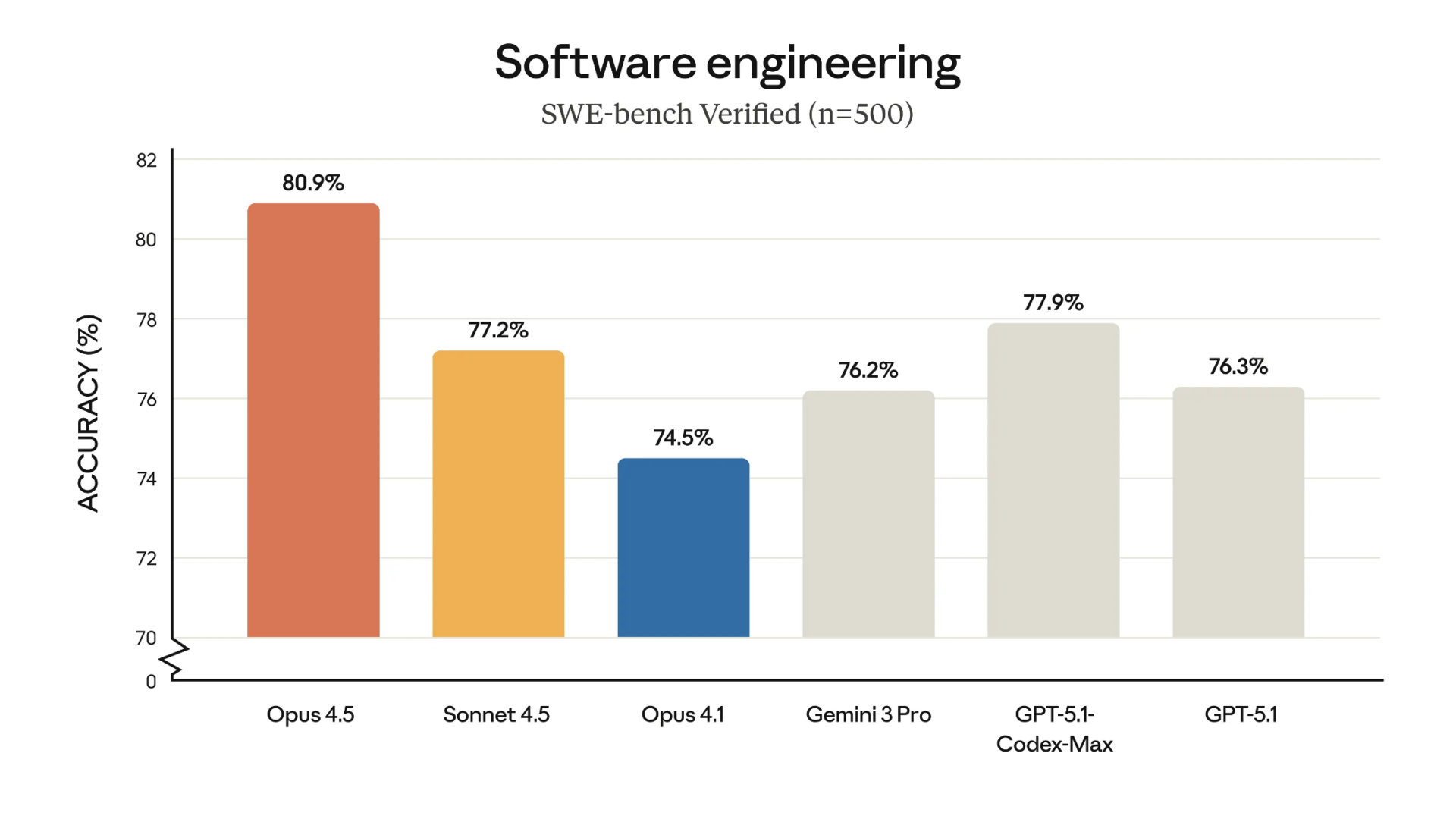
Opus 4.5 sets new records across coding, reasoning, and agentic-use benchmarks.
It became the first model ever to surpass 80% on SWE-Bench Verified, a leading real-world coding test.
It also leads on Terminal-Bench, tau2-Bench, MCP Atlas, ARC-AGI 2, and GPQA Diamond, signaling major strides in both reasoning and computer-use performance.
Anthropic highlights the model’s strength in tool use and system control, making it particularly suited for coding assistants, research agents, and enterprise automation.
🧩 Integrations: Claude for Chrome & Excel: Alongside the model, Anthropic is rolling out Claude for Chrome and Claude for Excel to a broader audience.
The Chrome extension, previously in pilot, lets users interact with Claude across any webpage — summarizing, autofilling, and contextualizing information in real time.
The Excel integration adds advanced formula debugging, data summaries, and code generation directly inside spreadsheets.
Chrome support is available to Max users, while the Excel-focused tool is expanding to Max, Team, and Enterprise tiers.
🧠 Memory & Endless Chat: A major under-the-hood change in Opus 4.5 is its new memory management system. According to Dianne Na Penn, Anthropic’s head of product management for research:
“Knowing the right details to remember is as important as having a longer context window.”
This upgrade powers a long-requested feature — Endless Chat — allowing conversations to continue seamlessly even when Claude hits its context limit. Instead of halting, the model now compresses older memory automatically, preserving continuity for the user.
🤖 Built for Agents: Anthropic designed Opus 4.5 for complex agentic workflows, where it can act as a lead agent commanding smaller Haiku-based sub-agents. These scenarios demand precise long-term memory and decision-making — areas where Opus 4.5’s architecture excels.
Penn notes that these improvements help Claude “explore codebases and documents intelligently — knowing when to backtrack, recheck, or delegate to a sub-agent.”
Opus 4.5 enters a crowded arena, following OpenAI’s GPT-5.1 (November 12) and Google’s Gemini 3 (November 18).
But Anthropic’s pitch is clear: where rivals chase multimodal flair, Opus 4.5 doubles down on reasoning depth, coding reliability, and controllability — the traits that power real-world agent systems.
Source: The White House
The White House has officially unveiled the Genesis Mission, a massive national effort to supercharge scientific discovery using AI.
The administration is framing it as the most ambitious U.S. science program since the Manhattan Project — but this time the goal is unlocking breakthroughs in energy, biotech, materials, national security, and advanced manufacturing.
Think of it as America’s attempt to build a federated super-platform for scientific AI: national-lab compute, federal datasets, autonomous labs, and AI agents working together to accelerate real-world research.
🧪 What the Genesis Mission Actually Is
The initiative creates a unified AI research infrastructure — called the American Science and Security Platform — that combines:
DOE supercomputers and secure cloud AI clusters
Scientific foundation models across fields
AI agents to automate research workflows
Access to the world’s largest federally curated datasets
Autonomous robotic labs and AI-augmented manufacturing pipelines
The idea: give scientists, agencies, and approved partners a single high-security system where experiments, models, data, and compute all operate in sync.
The administration argues this could massively accelerate breakthroughs in medicine, energy, materials, and national security — while multiplying the ROI on decades of federal R&D.
⚙️ How It Will Operate: The Department of Energy (DOE) takes point, integrating all relevant labs, compute, and data under a secure umbrella. Oversight comes from the White House’s Office of Science and Technology Policy (OSTP).
Key early steps include:
Mapping all available federal and cloud compute
Identifying the first datasets and models to onboard
Setting cybersecurity standards and access controls
Reviewing which national labs can support autonomous, AI-driven experimentation
Demonstrating the first working capability within nine months
Essentially, DOE has to turn decades of independent assets into one coordinated, AI-native research engine.
🧭 What Problems Will It Tackle?
Within 60 days, DOE must produce a list of at least 20 national science challenges, such as advanced manufacturing, biotechnology, and critical materials.
OSTP will expand this into a broader roadmap, and all participating agencies — from NASA to NIH to DOD — will run their research through the new Platform when appropriate.
🤝 Public–Private Collaboration Is Built In
The order encourages partnerships with universities, corporations, and startups — but with strict guardrails. DOE must set:
Uniform agreements for data use, model sharing, and IP rights
Strong cybersecurity and export-control requirements
Vetting procedures for every external collaborator
Standards for how AI-generated insights and experimental results are handled
Expect a mix of cooperative research agreements, user-facility programs, and selective industry access.
The Genesis Mission signals that the U.S. is preparing for a future where AI becomes a core scientific instrument — like the microscope, the particle accelerator, or the telescope.
Only this time, the instrument is a unified system capable of automating discovery itself.
If it works, it could reshape:
How medicines are discovered
How energy is generated
How materials are designed
How supply chains are secured
How quickly national labs can test, simulate, and iterate

Source: Waymo
Waymo just secured a major regulatory greenlight, giving it permission to operate fully autonomous vehicles across huge new sections of both Northern and Southern California.
The company already runs robotaxi services in San Francisco, Silicon Valley, and Los Angeles — along with other cities like Phoenix, Austin, and Atlanta.
With this new approval, its operational map in California just got dramatically bigger.
🗺️ Where Waymo Can Now Drive: New DMV maps show that Waymo can now test and deploy AVs across:
Bay Area + Northern California
Most of the East Bay and North Bay
Napa/Wine Country
Sacramento
Southern California
From Santa Clarita (north of L.A.)
All the way down to San Diego
It’s a huge expansion that effectively opens up the entire California coast for autonomous testing and deployment.
🚌 When Do the Rides Actually Start?
Regulators still need to approve passenger service in some of these new regions. But Waymo is already signaling where it wants to go first:
San Diego gets its first riders in mid-2026
That launch will join other planned 2026 cities, including Dallas, Denver, Detroit, Houston, Vegas, Miami, Nashville, Orlando, San Antonio, Seattle, and Washington, D.C.
At this point, Waymo’s rollout cadence is beginning to look like a national franchise map.
The company has been busy over the past few weeks:
Entering Minneapolis, New Orleans, and Tampa
Removing safety drivers in Miami ahead of commercial launch
Preparing freeway-enabled rides in L.A., San Francisco, and Phoenix

Source: u/mikkeelangelo via Reddit
Well, we don’t quite know how best to express the showcase. It’s exuding goth (obvs), futuristic, and honestly, Final Fantasy 😆.
🎯 Everything else you missed this week.
Source: Getty Images
⚡ The Neural Frontier’s weekly spotlight: 3 AI tools making the rounds this week.
1. 📊 ReadMeeting is an AI meeting assistant that records screen and audio simultaneously to generate automated summaries, action items, sentiment analysis, and exportable PDF reports with team organization features.
2. 🚀 Sprites AI is a marketing automation platform that converts task descriptions into executable workflows for SEO, Google Ads, competitor research, and content creation without manual setup.
3. 💬 Jotlin is an AI agent that conducts interactive interviews to transform vague ideas into structured product specifications, user stories, and professional documentation through guided conversations.
Wrapping up…
No additional remark today, just this: enjoy the holidays!
Stay curious, keep an eye on that inbox, and…we’ll catch you next week on the Neural Frontier ✨.
PS: Hit that Subscribe button if you haven’t already.